![[personal profile]](https://www.dreamwidth.org/img/silk/identity/user.png) wal_fool_runner
wal_fool_runner------------------------------------------------------------
Disclaimer: This was posted as part of an assignment for a class about technology use in the classroom. I have included three links, one of which is where the image came from (Pew Research Center), but I have not extensively researched what I have posted. Treat this as you would a random Substack article.
-----------------------------------------------------------------------------------------
One major upside of social media is that it connects people all across the world, in different locations, different stages of life, and different economic experiences, among many other otherwise defining-and-separating identifiers. However, connection is an open road: being connected to well-meaning strangers also often means being connected to malicious actors.
There are two things to keep in mind when online:
1. Everything is saved, for good.
2. Posts have a very wide reach.
Every so often I open Instagram or Youtube, and more than half the videos I see have someone's full face and voice included in the video. Often several people. These people are usually entertainers, or are making a journal, where keeping their likeness displayed on the screen is important. And if you're only sharing with a few people, or if you're alright with having your identity made public, then you can do this too.
But your data will almost certainly be used by advertisers, delving into the most private areas of your social media profiles to find what you might buy. Your data will be used to build a predictive model to steer your into or away from certain topics, keeping you engaged online rather than spending your time face-to-face with others. Your data will be said to be protected, but it will be leaked eventually, as all companies grow lax or corrupt with the vast data they collect on their userbase.
Public opinion, when polled, shows that this is not exactly a unique idea about our lack of privacy: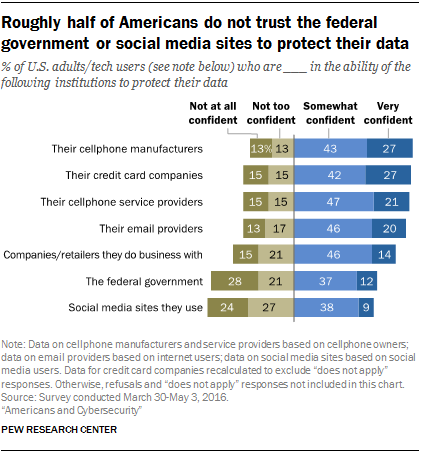
(Pew Research, https://www.pewresearch.org/short-reads/2018/03/27/americans-complicated-feelings-about-social-media-in-an-era-of-privacy-concerns/)
There are also blatant announcements from media companies that they have been collecting your data this entire time. Nearly a decade ago, Facebook promoted a Memories feature re-showing images from the past; even earlier, Spotify began its Wrapped feature which has spread in some form to other websites; more and more, as companies continue to amass your public and private data, they repackage it as a good thing.

(Spotify, 2025) (Discord, 2025)
I've read news articles, and several social media posts, talking about the lack of privacy in the digital age. Fortunately, there are a few things you can do to protect your privacy. They may not be appealing to most of you (students, parents, or fellow teachers), but I will list them out as options just in case you change your mind:
1. Do not post often, and if you do post often, curate what you post.
- Imagine that everyone will see what you post, because it's likely that they will.
- Know that your social media could influence your career, your credit score, and other facets of your life.
2. Use a password manager, and change your password every so often.
- Passwords are the key to any online service, and they may be leaked from less- and even positive-reputable companies.
3. Opt out of data collection practices when possible.
- Most social media allow users to toggle settings that reduce the amount of data collected.
- These toggles do not meaningfully reduce quality of the user experience, but they can potentially guard your privacy better.
Everything you post will, in all likelihood, be seen eventually and used by advertisers and other impersonal actors. But you have some choice in the matter.
Here's a poster to tie it all together; found a template on Canva and added some text and shapes.
References and Readings:
----------------
1. https://www.pewresearch.org/short-reads/2018/03/27/americans-complicated-feelings-about-social-media-in-an-era-of-privacy-concerns/
2. https://digitalprivacy.ieee.org/publications/topics/privacy-risks-and-social-media/
3. https://epic.org/issues/consumer-privacy/social-media-privacy/


